

Building a curriculum that encourages students to use diverse research methods to understand the relationship of firearms to American life: That’s been a central tenet of the Center for the Study of Guns and Society (CSGS) since its inception.
At the fourth-annual CSGS Undergraduate Research Conference in April 2026, the fruits of that labor were on full display. Several students from and beyond Wesleyan University presented projects, panel discussions, and posters based on their work.
“I could not be prouder of our students for working together to define new cutting-edge models of pedagogy and research,” said Jennifer Tucker, founding director of CSGS. Nearly two dozen Wesleyan undergraduates and two graduate students participated in the conference, along with students from Trinity College and Amherst College.
“They are strong examples of the finest scholarship and teaching.”
Unearthing interdisciplinary insights (figuratively and literally)
Several Wesleyan students presented research they conducted in partnership with the Hazel Quantitative Analysis Center under the leadership of Maryam Gooyabadi, assistant professor of practice. During the conference’s opening panel discussion, Grace Lee ’29 spoke about her work mapping U.S. social movements, gun laws, and NRA messaging over time. In the conference’s final panel, Ethan Chu ’26, Eli Cohen ’28, and PhD candidate Roberto Torres discussed projects that explored the history of firearm patents and technology.
Assistant Professor Joseph Slaughter moderated a panel composed of four students in his popular course, “God & Guns: The History of Faith and Firearms in America.” Maggie Smith ’27, Jake Klasky ’28, Keira Walsh ’28, and Parker McCoog ’29 shared insights from their research about a variety of topics, including violence and the Church of Latter-Day Saints and Christianity’s influence on gun policy in Louisiana.
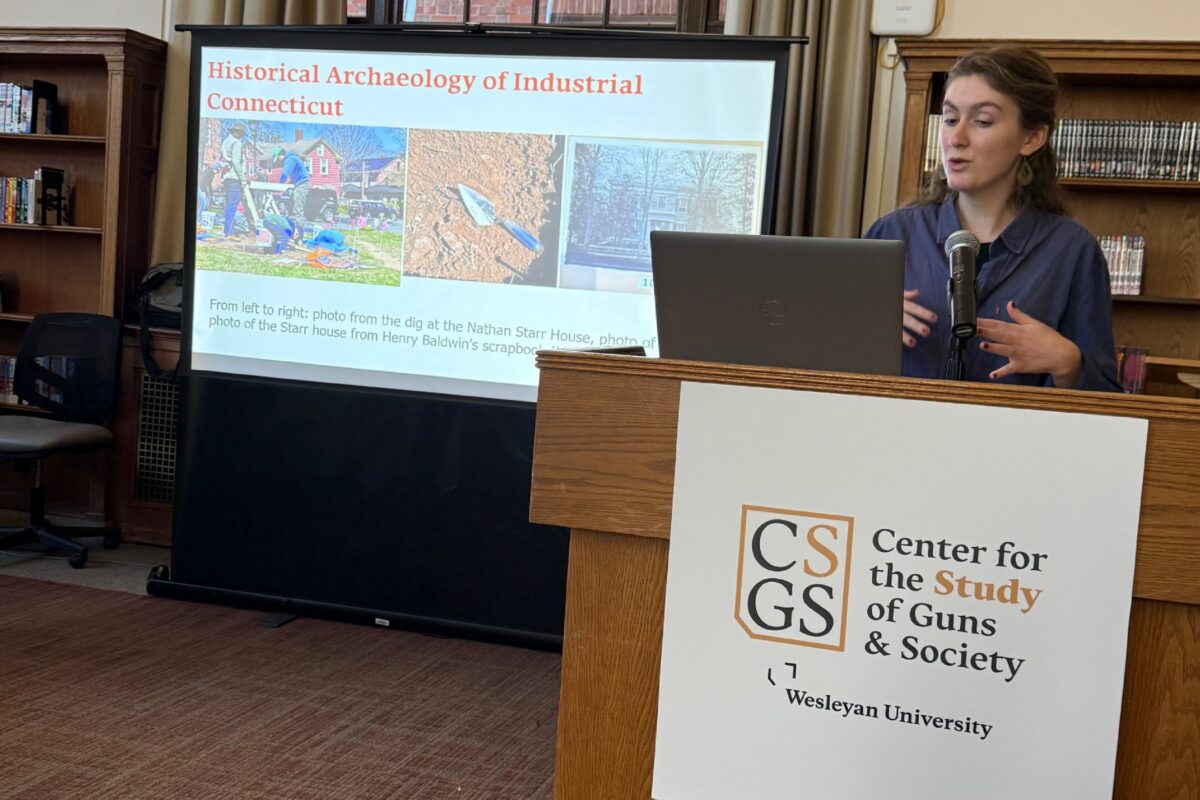
During the lunch hour, students from a new interdisciplinary course presented posters about their work. The course, “History and Archaeology of Industrial Connecticut,” co-taught by Tucker and Associate Professor of Archaeology Katherine Brunson, was funded by a Mellon Foundation grant and built on CSGS’ resources.
Through the course, students learned about Middletown’s history in firearms manufacturing and industrial production, attended a live excavation at the Nathan Starr House, and learned how objects and sites can reveal hidden traces of a society’s agriculture, textile, and industrial production history. The presenters were: Elizabeth Berke ’26, Katherine Currie ’26, AP Didier ’26, Ian Moran ’26, Mae Cohen ’27, Cecilia Coughlin ’27, Brynn Heller ’27, Caroline Johnson ’27, Alex Lara ’27, Rebecca Avelar ’28, Alex Fox ’28, and Magnolia Willey’ 29.
Before the lunch break, Fiona O’Reilly ’26 spoke about interdisciplinary research she conducted as a course assistant for “History and Archaeology of Industrial Connecticut.” Her work—which focused on the work of George Brown Goode, the first curator of the Wesleyan University Museum—was a great segue to keynote speaker Ken Cohen from the Smithsonian Museum of American History. Cohen, who chairs the museum’s Division of Military & Society and serves as the curator for Early American History at the museum, focused on the complexities of displaying and interpreting firearms for the general public.
CSGS collaborators return—and bring their own students
Evan Turiano, a former CSGS postdoctoral researcher, brought three of his Trinity College students to discuss a series of contemporary legal proceedings involving firearms. Now a visiting professor of public policy and law, he credits his work at CSGS with inspiring his Trinity course, “Guns in American Law and Policy.”
“My students read scholarship written by scholars affiliated with CSGS from a range of disciplines, including history, constitutional law, public health, and beyond,” he said. “The CSGS approach to gun studies, grounded in interdisciplinarity and the liberal arts tradition, shapes every aspect of how I teach.”
Amherst College Associate Professor of Political Science Jonathan Obert—a longtime CSGS collaborator—attended the conference with one of his advisees, Henry Lahue. Lahue spoke in the conference’s opening panel about his senior thesis, “Nihilistic Terror: Contemporary School Shooters and Their Manifestos.” Through thematic, ideological, comparative textual, and network analyses, his thesis argues that authorities should focus more closely on how extremist online groups are influencing school shooters.
As the conference concluded, Turiano expressed gratitude for the chance to introduce his students to the unique scholarly environment CSGS has fostered for undergraduate and graduate students interested in the study of firearms and society.
“They received tremendous feedback, learned so much from other presentations, and left with a renewed sense of the breadth of inquiry taking place at this vital intellectual community,” he said.